



Why is your resume not getting interviews?
You’ve applied to dozens of jobs. Maybe even hundreds.
And still, nothing.
No replies. No interviews. Just silence.
Let’s be honest, how to test your resume for ATS compatibility is exactly where most job seekers start questioning everything. Your experience is solid. Your skills are real. You know you can do the job. But something is clearly not working.
Most job seekers don’t realize this, but the problem is often not your experience. It’s how your resume is being read, or more accurately, not being read.
Before a recruiter ever sees your resume, it usually has to pass through an Applicant Tracking System (ATS). If your resume is not formatted or structured correctly, it might never reach a human at all.
This is exactly why learning how to test your resume for ATS compatibility has become essential, not optional.
If you’re applying and hearing nothing back, this might be why.
What is ATS and why it matters more than ever

An ATS, or Applicant Tracking System, is software used by companies to filter job applications before a recruiter sees them.
Think of it as a digital gatekeeper.
It scans your resume for keywords, structure, formatting, job titles, and relevance to the job description. If your resume does not match what the system is looking for, it gets filtered out automatically.
Most mid to large companies use ATS systems. That means even strong candidates get rejected before a human review.
This is where a lot of resumes quietly fail.
And here’s the hard truth, ATS systems are not forgiving.
They don’t interpret creativity. They don’t “figure out” your experience. They only match data.
That’s why ATS-friendly resume formatting has become one of the most important parts of modern job searching.
How ATS actually reads your resume

To test your resume properly, you first need to understand what ATS is looking at.
Most systems scan in this order:
- Job title relevance
- Keyword matches
- Work experience structure
- Skills section
- Formatting clarity
If any of these are unclear, your resume score drops.
Here’s what ATS struggles with:
- Complex formatting or columns
- Graphics or icons
- Non-standard fonts
- Missing keywords from job description
- Poor section labeling
Even small things like “Work History” vs “Professional Experience” can change how your resume is interpreted.
Most job seekers don’t realize this until it’s too late.
Step 1: Run a basic ATS resume test
Before anything else, start simple.
Copy your resume into a plain text editor. If it becomes messy or unreadable, ATS will likely struggle too.
Ask yourself:
- Does it still make sense without formatting?
- Are job titles and dates clear?
- Can I identify skills quickly?
If the answer is no, you already have a formatting problem.
This is one of the fastest ways to understand why resumes get rejected.
Step 2: Compare your resume with the job description
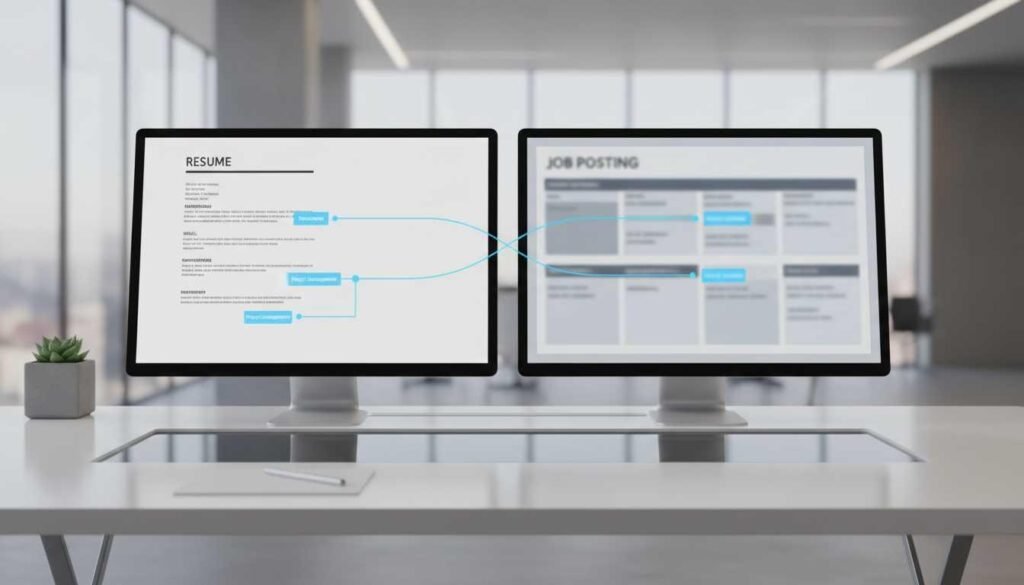
This is where most people miss the mark.
Take a job posting you want to apply for and highlight keywords like:
- Required skills
- Tools and software
- Job titles
- Industry terms
Now check your resume.
Do those exact terms appear naturally?
ATS systems are literal. If the job says “Project Management,” but your resume says “Project Handling,” the system may not match it.
This is where resume writing service professionals focus heavily, keyword alignment without stuffing.
Step 3: Check your resume formatting
ATS systems prefer simplicity.
A clean ATS-friendly resume usually includes:
- Single column layout
- Standard fonts like Arial or Calibri
- Clear headings
- No tables or text boxes
- Simple bullet points
Avoid anything that looks “designed.”
Let’s be honest, a visually creative resume might look nice, but ATS systems often misread it.
If you’re unsure, strip it down. Simplicity usually wins.
Step 4: Balance Your Keywords for ATS

Keywords are not just buzzwords. They are signals.
Your resume should naturally include terms from the job description, especially:
- Core technical skills
- Certifications
- Tools and platforms
- Industry language
But here’s the mistake most people make.
They either:
- Overload keywords unnaturally
- Or don’t include them at all
Both can hurt your chances.
A professional human resume writing service focuses on balancing keywords so they pass ATS but still feel human when read.
Step 5: Run it through ATS scanning tools

There are many online tools that simulate ATS systems.
They help you see:
- Keyword score
- Formatting issues
- Missing skills
- Readability problems
While no tool is perfect, they give a useful baseline.
But remember, ATS tools don’t replace human judgment. They only show technical compatibility.
If your score is low, it usually means your resume needs structural improvement, not just keyword tweaks.
Common resume mistakes that fail ATS tests
Most resumes fail for surprisingly simple reasons.
Here are the most common issues:
- Using creative templates that break parsing
- Missing job-specific keywords
- Overly long resumes without structure
- Unclear job titles or dates
- Mixing multiple roles without clarity
- Using graphics or charts
- Submitting PDF files with broken formatting
If you recognize even two of these, your resume might already be getting filtered out.
Resume vs AI resume: why automation alone is not enough
There is a growing trend of AI-generated resumes.
They look clean. They are fast. But they are often generic.
Here’s the problem.
AI resumes usually lack:
- Real career context
- Strategic keyword placement
- Role-specific positioning
- Human storytelling
ATS might accept them, but recruiters often don’t connect with them.
A strong resume is not just about passing software. It is about getting interviews.
That balance is where human expertise still matters.
This is also why many professionals turn to a professional resume writing service when they stop getting responses.
Real Case Example: when ATS was the silent problem

We recently worked with a mid-level operations manager who had applied to over 60 roles without a single interview.
On paper, his experience was strong. But his resume had three key issues:
- It used a two-column design that ATS could not read properly
- Keywords did not match job postings
- Job titles were inconsistent across roles
After a full resume review and rebuild:
- The formatting was simplified
- Keywords were aligned with target roles
- Experience was restructured for clarity
Within weeks, interview calls started coming in.
Same experience. Different presentations.
That’s the power of ATS optimization.
Signs your resume is not ATS compatible
If you are unsure, here are clear warning signs:
- You are applying but getting no responses
- Recruiters are not viewing your profile
- Your resume looks “designed” rather than structured
- You are not tailoring resumes to each job
- You are relying on templates
- You have not updated keywords in years
If two or more apply to you, your resume likely needs professional review.
ATS-friendly resume checklist
Before submitting any application, check this:
- Simple one-column format
- Clear section headings
- Keywords from job description included naturally
- Standard file type (PDF or Word)
- No graphics or icons
- Easy-to-scan bullet points
- Relevant job titles aligned with industry
This alone can significantly improve your visibility in ATS systems.
Myths about ATS resumes
Let’s clear up some common misunderstandings.
Myth 1: More applications fix the problem
No. If your resume is not optimized, more applications only increase rejection.
Myth 2: Templates are enough
Templates help structure, but they don’t guarantee ATS success.
Myth 3: ATS is the only problem
Not always. Sometimes the issue is positioning, not just software.
Myth 4: AI resumes are enough
They are a starting point, not a complete solution.
When professional help makes a difference

If you’ve tested your resume and still feel stuck, it might not be a small fix anymore.
This is where a professional resume writing service becomes valuable.
At a deeper level, it is not just about rewriting your resume. It is about:
- Understanding how recruiters think
- Aligning with ATS systems
- Positioning your experience correctly
- Improving LinkedIn optimization alongside your resume
- Supporting your overall job application strategy
We have helped professionals across industries improve their resumes, from mid-career transitions to executive-level job searches.
Sometimes, an outside perspective is exactly what breaks the cycle of silence.
If you are also struggling with visibility on LinkedIn, pairing your resume with proper LinkedIn optimization can significantly improve your reach.
And if you want structured guidance, a resume review is often the fastest way to identify what is going wrong.
You can also explore resume help packages or consultation options depending on how much support you need.
Frequently Asked Questions
Why is my resume not getting interviews?
Most likely due to ATS filtering, weak keyword alignment, or unclear structure.
Are ATS-friendly resumes really important?
Yes. Most companies use ATS before a recruiter sees your application.
Is it worth hiring a resume writer?
If you are not getting interviews despite strong experience, yes. A resume expert improves structure, keywords, and positioning.
How long should a resume be?
Usually one to two pages depending on experience level.
Can a resume help me switch careers?
Yes, if it is strategically written to highlight transferable skills.
What is reverse recruiting?
It is a service where professionals actively apply and position candidates for better job opportunities on their behalf.
Final thoughts
Testing your resume for ATS compatibility is not just a technical step. It is a career strategy.
Because at the end of the day, your resume is not just a document. It is your first impression in a system that decides whether you even get seen.
A good resume does more than list your experience. It tells your story in a way that makes someone want to interview you.
And if that story is not getting through, it is not always about your experience. Sometimes, it is just about how that story is being told.