


You’ve probably been here before.
You update your resume late at night, scroll through advice online, and suddenly you are stuck in the same loop again about resume length.
One page or two pages. Keep it short. No, add more detail. Recruiters prefer brevity. But senior roles need depth.
Then you apply anyway.
And nothing happens.
No interviews. No feedback. Just silence.
Let’s be honest, most job seekers don’t struggle because they lack experience. They struggle because their resume is not communicating that experience in the right way.
Resume length is usually not the real problem. But it is often where confusion shows up first.
What Is the Right Resume Length for Getting Interviews

There is no universal rule for resume length anymore.
That “one page only” advice is outdated in most industries.
Today, hiring is driven by:
- Applicant tracking systems
- Keyword matching
- Rapid recruiter scanning
- Shortlisting under time pressure
So the real question is not how long your resume should be.
It is whether your resume is doing its job.
Is it clear?
Is it relevant?
Does it make someone want to read further?
If not, page count will not save it.
Why Your Resume Is Not Getting Interviews
If you are applying and hearing nothing back, this might be why.
Most resumes fail for reasons that have nothing to do with length.
Here are the most common issues we see in our resume review work:
- Generic job descriptions instead of achievements
- No measurable impact or results
- Weak keyword alignment with job postings
- Poor structure that confuses ATS systems
- Lack of clarity in career direction
- Overwritten or underwritten content
This is where a lot of resumes quietly fail.
Not because they are one page or two pages. But because they do not clearly communicate value.
How ATS Actually Impacts Your Resume

ATS, or Applicant Tracking Systems, are often misunderstood.
They are not judging you. They are filtering information.
An ATS-friendly resume is designed to:
- Match keywords from job descriptions
- Structure content in readable sections
- Identify relevant job titles and skills
- Remove formatting confusion
If your resume is not structured correctly, it may never reach a human recruiter.
We have seen strong candidates rejected simply because their resume formatting was not compatible with ATS parsing rules.
That is why understanding how to pass ATS matters more than obsessing over page length.
What Is the Right Resume Length?
Let’s simplify this in a practical way.
One page resume works best when:
- You are early in your career
- You have under 5 to 7 years of experience
- Your roles are similar and focused
- You can clearly show impact without losing meaning
Two page resume works best when:
- You are mid-career or senior level
- You have 8 to 20+ years of experience
- You manage teams or complex responsibilities
- You need space to show measurable achievements
- You are switching industries
Most job seekers don’t realize this, but forcing everything into one page often removes the very achievements that get you hired.
What Recruiters Actually Look For
We have worked with hiring managers across industries, and the pattern is consistent.
Recruiters do not care about page count.
They care about:
- Relevance to the job
- Clear impact and outcomes
- Career progression that makes sense
- Keywords that match the role
- Fast readability
A recruiter might spend 10 to 20 seconds on your resume initially.
In that time, they are not counting pages. They are scanning for signals.
Resume Mistakes That Matter More Than Length
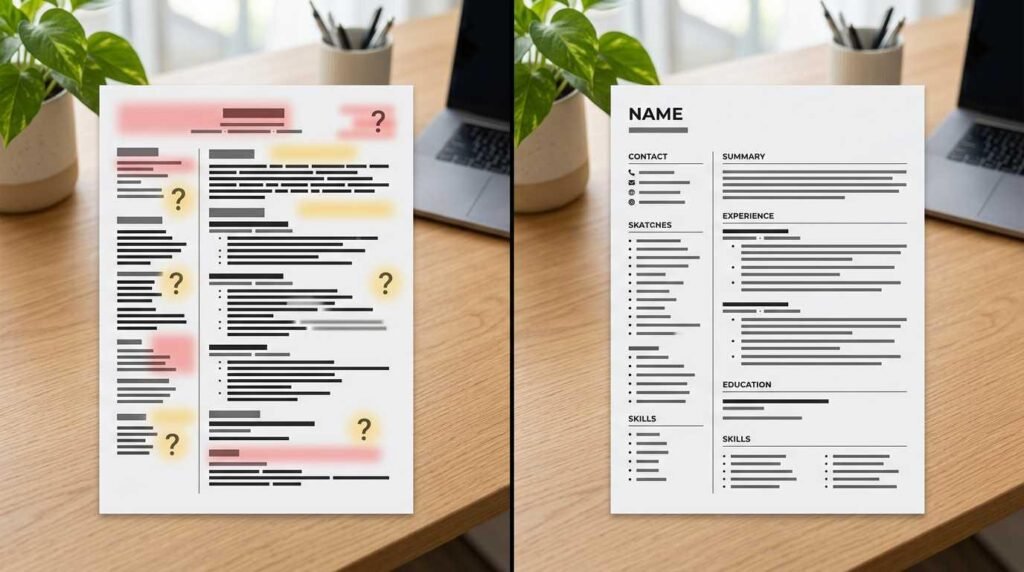
Let’s break down the real issues that affect hiring outcomes.
Common resume mistakes:
- Writing job duties instead of achievements
- Using vague statements like “responsible for”
- No numbers or measurable results
- Missing important keywords
- Poor formatting and spacing
- No alignment with LinkedIn profile
What works better:
- Strong achievement based bullet points
- Metrics and results wherever possible
- Clear structure with defined sections
- ATS-friendly formatting
- Consistency with LinkedIn optimization
This alignment is often more important than anything else.
AI Resume vs Human Strategy
There is a growing trend of using AI tools to generate resumes.
On the surface, it feels efficient.
But in real hiring environments, a resume vs AI resume comparison shows a clear difference.
AI resumes often:
- Sound generic and repetitive
- Lack real career context
- Miss industry specific nuance
- Fail to highlight real achievements
Hiring managers can usually identify them quickly.
This is why many candidates still struggle even after using automated tools.
A strong resume needs strategy, not just text generation.
Real Case Study: When Length Was Never the Problem
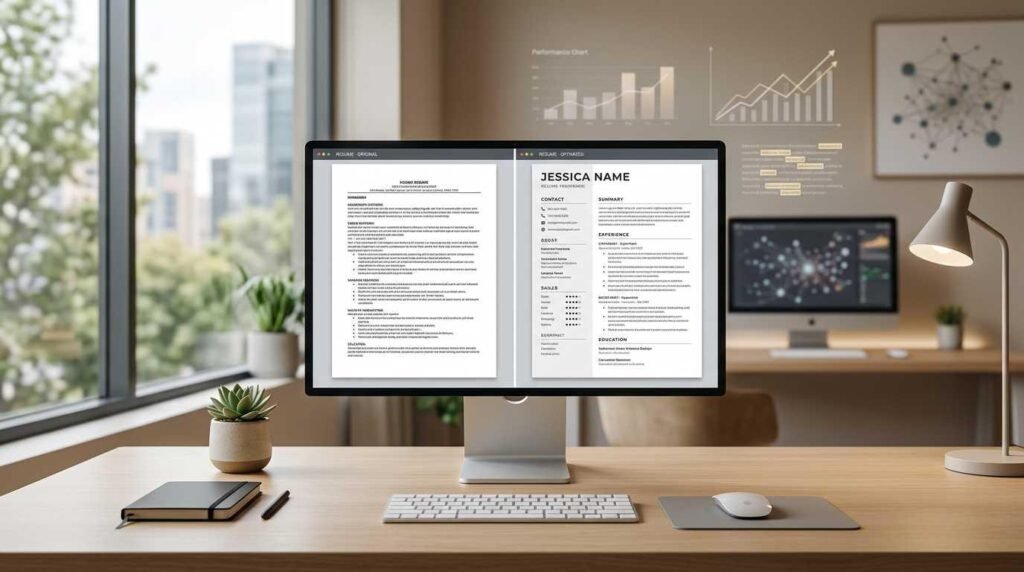
We worked with a mid-level operations manager who believed their issue was resume length.
Their resume was one page. Clean. Simple. Easy to read. But they were getting no interviews.
After a detailed resume review, the problem became clear:
- No measurable achievements
- No leadership outcomes
- Weak keyword alignment
- No clear value positioning
We rebuilt the resume into two pages with:
- Clear performance metrics
- Leadership and project outcomes
- Industry relevant keywords
- Structured storytelling of career growth
Within weeks, interview calls started coming in.
Same experience. Same person. Different presentations.
That is the power of proper resume strategy.
Resume and LinkedIn Must Work Together
One of the most overlooked issues in job search today is inconsistency between resume and LinkedIn.
Recruiters cross check both.
If your resume says one thing and your LinkedIn says another, it creates doubt.
That is why LinkedIn optimization is often part of our professional resume writing service process.
We have seen candidates lose opportunities simply because their digital presence was not aligned.
Signs Your Resume Needs Help
If you are unsure whether your resume is working, here are clear indicators:
- You are applying consistently but getting no replies
- You are unsure how to present your achievements
- You are constantly changing resume format
- You feel your experience is not being recognized
- You are confused about ATS requirements
If this sounds familiar, it may be time for structured resume help.
When Professional Resume Help Makes Sense

Let’s be practical.
A resume is not just a document. It is a positioning tool.
A professional resume writing service can help you with:
- ATS-friendly resume structure
- Achievement based rewriting
- Keyword optimization for target roles
- Career transition positioning
- LinkedIn optimization alignment
- Cover letter support
We have helped professionals across industries improve their resumes and finally start getting interviews after long periods of silence.
Sometimes the issue is not your experience. It is how that experience is being presented.
You can explore our resume writing standards, pricing packages, or learn how the process works through our internal service pages.
Mistakes Job Seekers Keep Making
Let’s clear up a few myths.
Myth 1: More applications equals better results
Not true. Targeted applications with a strong resume perform better.
Myth 2: Templates fix everything
Templates only structure content. They do not improve messaging.
Myth 3: ATS is the only problem
ATS is one part of the system, not the entire issue.
Myth 4: AI resumes are enough
AI tools help, but they cannot replace strategy and context.
Frequently Asked Questions
Why is my resume not getting interviews?
Usually due to weak positioning, missing keywords, or lack of measurable achievements rather than length.
Are ATS-friendly resumes really important?
Yes. Many companies filter resumes through ATS before a recruiter sees them.
Is it worth hiring a resume writer?
If you are not getting interviews despite strong experience, professional help can significantly improve outcomes.
How long should a resume be?
One page for early career professionals, two pages for mid to senior professionals with relevant experience.
Can a resume help me switch careers?
Yes, if it is strategically rewritten to highlight transferable skills and relevant positioning.
What is reverse recruiting?
It is a service where experts help manage and optimize your job search and applications.
Final Thoughts
So what is the definitive answer?
One page or two pages is not the real question.
Clarity is.
Relevance is.
Strategy is.
A resume is not meant to impress by length. It is meant to create interest fast enough for someone to want to talk to you.
From everything we have seen working across industries, the strongest resumes are not defined by how short or long they are.
They are defined by how clearly they communicate value.
A good resume does more than list your experience. It tells your story in a way that makes someone want to interview you.