



When your experience is strong, but your resume isn’t
You’ve worked long shifts. Handled patients under pressure. Made decisions that actually mattered in real life situations.
And yet, when you apply for new healthcare roles, nothing happens.
No interview calls. No feedback. Just silence.
Let’s be honest, this is where a lot of healthcare professionals get stuck. Not because they are unqualified, but because their resume does not translate clinical experience into hiring language.
If you’re applying and hearing nothing back, this might be why your resume is not passing ATS filters or speaking the recruiter’s language.
This guide breaks down the best resume services for healthcare workers, how they actually differ, and what really matters when choosing a professional resume writing service that understands healthcare careers.
Healthcare Resume Writer: What You Get
A healthcare resume writer builds an ATS-ready resume around your clinical credentials, licenses, and patient-care outcomes. A professional healthcare resume writer knows how hospital and clinic recruiters screen applicants, so your experience is framed to win interviews. See our nurse and healthcare resume writer service.
Medical Resume Writers for Clinical Roles
Medical resume writers handle the details general writers miss: certifications, EMR systems, specialties, and compliance language. A medical resume writer translates your clinical work into measurable results that pass ATS filters and impress human reviewers.
Healthcare Resume Writing Service: How It Works
A healthcare resume writing service pairs you with a specialist who writes, optimizes, and tailors your resume to your target role. Compare the top healthcare resume writing services below, or start with our resume writing service.
Healthcare Executive Resume Writers
Healthcare executive resume writers focus on leadership roles like nurse managers, directors of nursing, and hospital administrators, highlighting budget, team, and patient-outcome metrics that executive search teams look for.
Why Healthcare Resumes fail more often than expected

Healthcare is one of the most misunderstood industries when it comes to resumes.
Most job seekers assume:
- “My experience speaks for itself”
But recruiters and ATS systems don’t interpret experience the way humans in the field do.
Most common issues we see:
- Clinical tasks listed instead of measurable outcomes
- Missing certifications or improperly formatted licenses
- Weak keyword alignment with job postings
- No clear specialization (nursing, admin, allied health, etc.)
- Poor ATS-friendly resume structure
This is where a lot of resumes quietly fail.
Even highly skilled nurses, technicians, and healthcare administrators get rejected before a human ever sees their application.
How ATS Systems evaluate Healthcare resumes

Before we compare services, you need to understand what is actually filtering you out.
ATS systems scan for:
- Job title alignment (RN, LPN, Medical Assistant, etc.)
- Clinical keywords (patient care, triage, EHR systems, HIPAA compliance)
- Certifications (BLS, ACLS, PALS, etc.)
- Measurable experience
- Clean formatting
If your resume is not optimized, it doesn’t matter how strong your background is.
This is why many professionals search for common resume mistakes or wonder why resumes get rejected despite being qualified.
What makes a good Healthcare resumes service

Not all resume providers are the same. Some simply rewrite templates. Others understand hiring psychology in healthcare.
A strong healthcare-focused resume writing service should offer:
Industry-specific expertise
They should understand:
- Clinical roles
- Hospital hiring systems
- Private practice expectations
- Healthcare compliance language
ATS optimization
Your resume must be structured to pass automated systems without losing readability.
Credential handling
Healthcare resumes must highlight certifications correctly and prominently.
LinkedIn optimization
Recruiters often cross-check LinkedIn before interviews. Your profile must align with your resume.
Role targeting strategy
A good service does not just write your resume. It positions you for specific job outcomes.
This is where professional resume writing service providers differ significantly in quality.
Types of resume services for healthcare workers

Let’s break down the main options job seekers usually consider.
Template-based resume services
Pros:
- Fast delivery
- Low cost
- Easy to use
Cons:
- Generic content
- Weak ATS performance
- No personalization
- Often fails in competitive healthcare roles
Best for:
Entry-level applicants with simple job history
AI resume tools
Pros:
- Instant generation
- Keyword suggestions
- Formatting assistance
Cons:
- Lacks real healthcare context
- Produces generic statements
- Often misses clinical depth
This is where resume vs AI resume becomes clear. AI can assist, but it cannot interpret your career story properly.
Best for:
Drafting ideas, not final applications
Freelance resume writers
Pros:
- More personalized than templates
- Some industry understanding
- Moderate pricing
Cons:
- Quality varies significantly
- Not always ATS specialists
- Limited healthcare expertise in many cases
Best for:
Mid-level professionals needing moderate improvement
Specialized Healthcare resume writing service
Pros:
- Deep healthcare industry knowledge
- Strong ATS optimization
- Strategic positioning for roles
- Includes LinkedIn optimization
- Focus on measurable clinical outcomes
Cons:
- Higher cost
- Longer turnaround time
Best for:
- Nurses
- Healthcare administrators
- Allied health professionals
- Career switchers entering healthcare
- Senior clinical leaders
This is typically where serious job seekers see the biggest improvement in interviews and callbacks.
Side-by-Side Comparison Table
| Option | ATS Optimization | Healthcare Expertise | Customization | Interview Impact |
| Templates | Low | Low | Low | Low |
| AI Tools | Medium | Low | Medium | Low |
| Freelancers | Medium | Medium | Medium | Medium |
| Specialized Resume Service | High | High | High | High |
Real case example: Nurse struggling with job applications
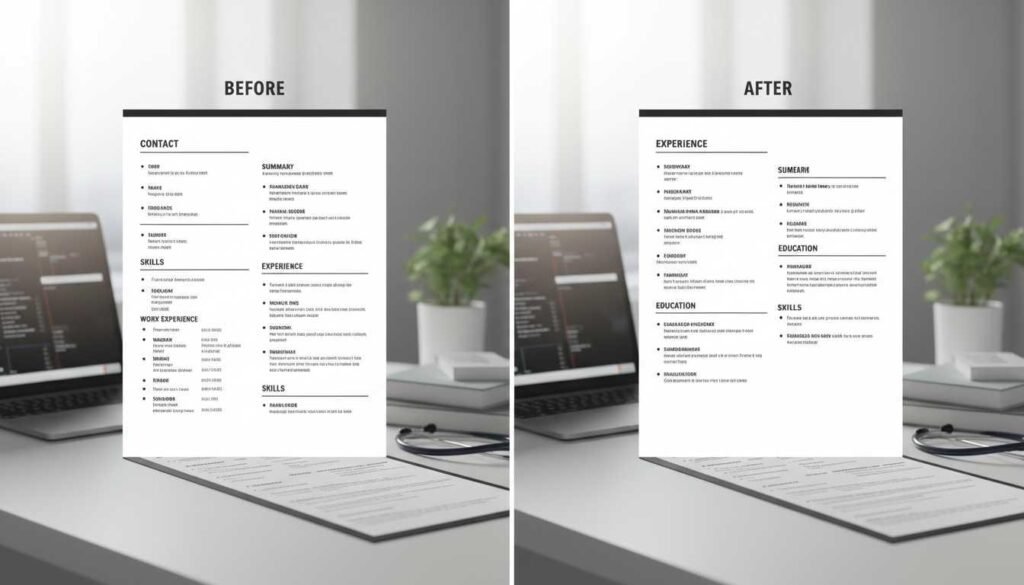
Let’s look at a real-world scenario we often see in resume review sessions.
Before:
A registered nurse with 6 years of hospital experience applying to new roles.
Resume issues:
- Listed duties instead of impact
- No mention of patient outcomes
- Certifications buried at the bottom
- Generic phrasing like “responsible for patient care”
Result:
- 40+ applications
- 0 interviews
After professional resume writing service:
- Rewritten with clinical outcomes
- Highlighted emergency response experience
- ATS keywords optimized for hospital systems
- Certifications placed strategically
- LinkedIn optimized to match resume
Result:
- Interview calls within 2 weeks
- 3 hospital shortlists
- Higher salary negotiation leverage
This is not rare. It is a pattern we see often when resumes are properly repositioned.
Common resume mistakes healthcare professionals make
Resume mistakes:
- Overloading with daily tasks
- Ignoring metrics (patients handled, outcomes improved)
- Missing keyword alignment
- Weak summary section
- No leadership or initiative highlights
ATS tips:
- Use standard job titles
- Avoid complex formatting
- Include full certification names
- Match keywords from job descriptions
Do’s:
- Show measurable impact
- Highlight patient outcomes
- Use healthcare-specific terminology
- Keep formatting clean and structured
Don’ts:
- Copy job descriptions
- Overuse generic statements
- Ignore LinkedIn alignment
- Use non-standard abbreviations
Why do Healthcare resumes get rejected?
Most job seekers assume rejection is about experience.
In reality, it is often about:
- Poor keyword alignment
- Weak formatting for ATS
- Lack of role clarity
- No measurable achievements
If you are applying and hearing nothing back, this might be why.
Recruiters are not rejecting you personally. They are filtering resumes that don’t match system expectations.
Resume and LinkedIn alignment matters more than you think

Healthcare recruiters frequently check LinkedIn before shortlisting.
If your resume says “Senior Nurse” but LinkedIn still shows outdated roles, it creates doubt.
A strong LinkedIn optimization strategy ensures:
- Consistent job titles
- Matching achievements
- Clear career progression
- Professional healthcare positioning
This alignment often improves visibility significantly.
When professional help actually makes sense
You probably do NOT need help if:
- You are getting regular interview calls
- Your role is entry-level with simple responsibilities
But you SHOULD consider help if:
- You are not getting interviews despite experience
- You are applying to hospitals or competitive roles
- You are changing specialties or career paths
- You are unsure how to position your experience
This is where a resume review or consultation becomes valuable.
We have helped professionals across healthcare roles improve their resumes and finally get noticed by hiring teams.
Myths about healthcare resumes
“More applications means better results”
No. Better targeting matters more than volume.
“Templates are enough”
Templates do not understand your clinical impact.
“ATS is the only problem”
ATS is part of it, but messaging and positioning matter just as much.
“AI resumes are good enough”
AI can support writing, but it cannot replace strategy or industry context.
Frequently Asked Questions
Why is my resume not getting interviews in healthcare?
Most likely due to ATS issues, weak keywords, or lack of measurable clinical outcomes.
Are ATS-friendly resumes really important for healthcare jobs?
Yes. Many hospitals and healthcare systems use ATS to filter applications before human review.
Is it worth hiring a resume writer for healthcare roles?
Yes, especially for nurses, specialists, and senior healthcare professionals. It improves positioning and interview chances.
How long should a healthcare resume be?
Usually 1 to 2 pages depending on experience level.
Can a resume help me switch healthcare careers?
Yes, but it must highlight transferable clinical and administrative skills correctly.
What is reverse recruiting?
It is a job search support service where experts help you find, apply, and position yourself for roles instead of doing it alone.
Final thoughts
Healthcare professionals are some of the most experienced and capable candidates in the job market.
But experience alone does not get interviews. Positioning does.
A strong resume does more than list your duties. It shows impact, clarity, and readiness for the next role.
If your resume is not getting responses, it is not a reflection of your ability. It is a signal that your story is not being translated correctly.
And that is fixable.
Take the next step in your healthcare career
If you want to improve your chances of getting interviews, here are a few options:
- Get a free resume review to see what is holding your resume back
- Book a free consultation with a resume expert for personalized guidance
- Explore a professional resume writing service tailored for healthcare roles
- Ask about job application help or reverse recruiting support if you want hands-on assistance
You do not have to keep guessing why your applications are not working.
Sometimes, a small change in positioning is what finally gets your experience noticed.