



You’re Qualified… But Your Resume Isn’t Showing It
You’ve applied to dozens of jobs. Maybe more.
You tweak your resume each time. Add keywords. Try a new format.
Still nothing.
If you’re applying and hearing nothing back, this might be why.
Your resume is telling you about your past. But hiring managers are looking for your future.
Let’s be honest, that gap is where most career change resumes fall apart.
Why Career Change Resumes Quietly Fail
Most job seekers don’t realize this, recruiters are not trying to figure you out.
They are scanning for a quick yes or no.

When your job titles don’t match the role, your resume has to do more work in less time.
This is where a lot of resumes quietly fail.
Here’s what often goes wrong:
- Your experience looks unrelated at first glance
- Your transferable skills are not clearly defined
- Your resume is not aligned with ATS-friendly resume standards
- Your content focuses on responsibilities, not results
- There is no clear career direction
And here’s something important. Even if you figure out how to pass ATS, that alone will not get you interviews.
A human still needs to believe your story.
The Real Problem: You’re Not Translating Your Value
Career change resumes are not about adding more content.
They are about changing how your experience is interpreted.
Think about it this way.
You already have the skills. You just have not connected them to your target role in a way that makes sense to someone hiring.
That connection is everything.
What Recruiters Look for in Career Switchers
When reviewing a resume from someone changing careers, hiring managers are looking for signals of relevance.

They want to see:
- Transferable skills that match the role
- Evidence of impact, not just activity
- Clear intent, not confusion
- Some level of exposure to the new field
They are not expecting perfection.
But they are expecting clarity.
How to Transfer Your Skills on a Resume
Start With a Focused Professional Summary
Your summary should answer one question immediately.
Where are you going?
This is not a place to describe your entire career. It is where you position yourself for your next move.
Example:
“Marketing professionals transitioning into product management, with experience in user research, cross-functional collaboration, and data-driven decision making.”
Simple. Clear. Forward-looking.
Reframe Your Experience Around Outcomes
Listing job duties is easy. Showing value is harder.
Instead of this:
“Managed customer support tickets”
Try this:
“Resolved customer issues while identifying recurring product gaps, contributing to improved user experience and retention”
Now your work connects to a broader business impact.
This is exactly how a professional resume writing service approaches career transitions.
Align Your Resume With Job Descriptions
Every job posting gives you clues.
Look closely and you will find:
- Repeated keywords
- Required tools or systems
- Core competencies
Reflect those naturally in your resume.
This improves your chances of passing ATS filters and increases relevance for human reviewers.
Build a Skills Section That Supports Your Story
For career changers, your skills section plays a critical role.
Focus on:
- Hard skills and tools
- Industry-specific capabilities
- Transferable functional skills
Avoid vague terms.
Instead of “leadership”, show where and how you led.
Add Supporting Proof Through Projects
If your experience does not fully align yet, show effort.
Include:
- Certifications
- Online training
- Freelance or consulting work
- Personal projects
This shows that your career change is intentional, not accidental.
Resume vs AI Resume vs Human Strategy
There’s a lot of conversation right now about AI-generated resumes.
Some of it is helpful. Some of it leads people in the wrong direction.
Here’s a realistic comparison:
| Option | Strengths | Limitations | When It Works |
| AI Resume Tools | Fast, convenient | Generic, lacks nuance | Drafting ideas |
| DIY Resume | Flexible, low cost | Time-heavy, unclear strategy | Small updates |
| Professional Resume Writing Service | Strategic, tailored, ATS optimized | Requires investment | Career changes, senior roles |
AI can generate content quickly.
But it does not understand hiring behavior, industry expectations, or how to position a career shift effectively.
We’ve seen what actually works in hiring, and it’s rarely generic.
Case Study: From Finance to Data Analyst
A mid-career finance professional came to us after months of applying.
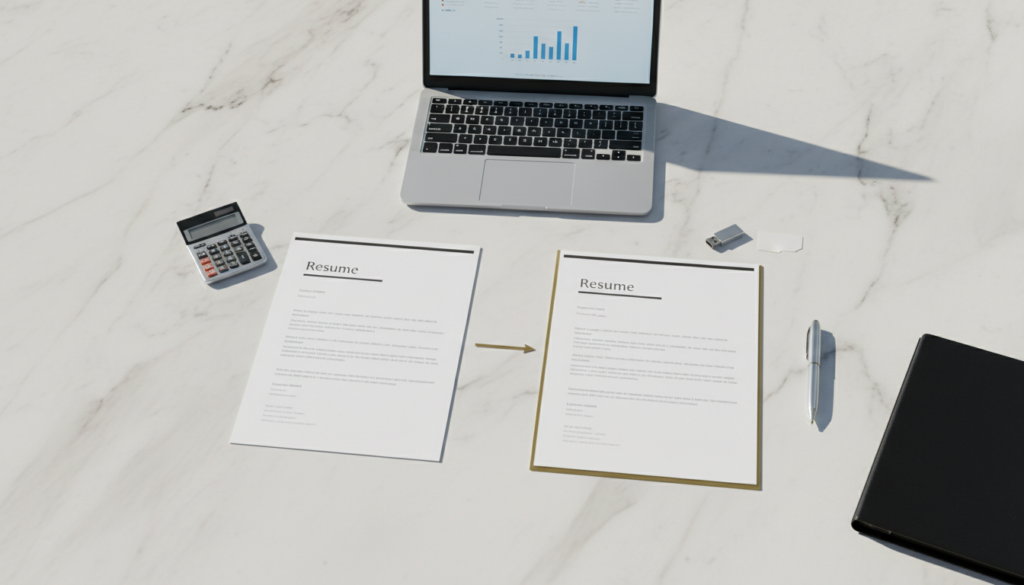
They had strong analytical experience, but their resume did not reflect data-focused roles.
Before:
- Focused heavily on reporting tasks
- No mention of tools like SQL or data visualization
- No clear direction toward analytics
After:
- Highlighted data analysis projects
- Added tools and technical skills
- Reframed achievements around insights and decision support
- Aligned language with job descriptions
Within a month, interviews started coming in.
Same background. Better positioning.
Common Myths About Career Change Resumes
“I need direct experience before applying”
Not always. You need relevant experience, not identical roles.
“If I apply more, I will eventually get lucky”
If your resume is not working, more applications will not fix it.
“ATS is the main issue”
ATS matters, but most resumes are rejected by humans, not systems.
“Templates or AI tools are enough”
They can help, but they do not replace strategy.
Why Your Resume Is Not Getting Interviews
If your resume is not getting interviews, it usually comes down to a few things:

- Lack of clear positioning
- Weak alignment with job requirements
- Missing keywords for ATS-friendly resume performance
- No strong narrative connecting your past to your future
This is where targeted resume help can make a real difference.
Beyond the Resume: What Else Matters
Your resume is important, but it does not work alone.
You also need:
- Strong LinkedIn optimization that reflects your new direction
- A focused job search strategy
- Targeted job application help
- Consistent messaging across platforms
For many professionals, managing all of this is overwhelming.
That is completely understandable.
When It Makes Sense to Get Professional Help
If you are serious about your career change and not seeing results, it might be time to consider support.

A professional resume writing service can help you:
- Clarify your direction
- Translate your experience effectively
- Build an ATS-friendly resume
- Strengthen your overall job search strategy
We have helped professionals across industries improve their resumes and successfully transition into new roles.
And we have seen what actually works in hiring environments today.
Signs You Should Get a Resume Review
- You are applying but not getting interviews
- You are unsure how to position your experience
- Your resume feels generic or unfocused
- You are relying on AI tools without results
- You feel stuck in your job search
A resume review can give you clarity quickly.
Frequently Asked Questions
Why is my resume not getting interviews?
Usually because it lacks clear positioning, relevant keywords, or a strong connection to the target role.
How do I make an ATS-friendly resume?
Use clear formatting, include relevant keywords, and align your content with job descriptions.
Can a resume really help me switch careers?
Yes, when it is written strategically to highlight transferable skills and relevant achievements.
Is hiring a resume writer worth it?
For career changes or when results are not coming, it can significantly improve your chances.
How long should a resume be?
One to two pages, depending on your experience and level.
What is reverse recruiting?
It is a service where professionals help manage your job search, including applying to roles on your behalf.
Ready to Move Forward?
If your resume is not getting interviews, it is worth understanding why before continuing to apply.
You can start with a free resume review to identify gaps and missed opportunities.
If you want deeper guidance, you can book a free consultation with a resume expert.
For full support, explore resume packages or ask about reverse recruiting if you need help managing your job search.
You can also visit our How It Works page, review our resume writing standards, or reach out through our contact page to get started.
Final Thoughts
Career changes are not just about finding a new job.
They are about repositioning your entire professional story.
That takes more than a quick resume update.
A good resume does more than list your experience. It shows how your past connects to what comes next.
And when that story is clear, hiring managers start to pay attention.