

You fix your resume. You use an AI tool. It gives you something that looks clean, structured, and professional.
You start applying with confidence. Then nothing happens.
No interviews. No feedback. Just silence.
Let’s be honest, this is one of the most frustrating experiences job seekers are dealing with in 2026. And most people assume the problem is effort or luck.
But in reality, the issue is much more specific.
AI-generated resumes are getting rejected more often because they are not built for how hiring actually works anymore.
If you are thinking about resumes not getting interviews, this is something you need to understand clearly.
The Illusion of a “Perfect” AI Resume

AI makes resumes look easy.
You paste your experience, and it returns:
- Clean formatting
- Strong sounding bullet points
- Keyword optimized content
- A polished summary
On the surface, it feels like progress.
But hiring is not about how polished your resume looks. It is about how clearly it communicates your value to a specific job. And that is where AI starts to fall short.
How Hiring Actually Works in 2026
Most companies today use a layered screening system.
Your resume usually passes through:
- ATS software
- Keyword filters
- Automated ranking systems
- Recruiter scanning (seconds per resume)
This means your resume has two jobs:
- Pass ATS filters
- Convince a human very quickly
This is why an ATS-friendly resume is important, but not enough on its own. Because even if you pass the system, you still need to persuade a person.
Why AI-Generated Resumes Are Getting Rejected

There are consistent patterns behind rejection. Let’s break them down in real terms.
They all sound the same
AI tools are trained on existing resume data.
That means they produce:
- Similar phrasing
- Repeated sentence structures
- Generic professional language
Recruiters see this constantly. And when everything sounds familiar, nothing feels memorable. This is where a lot of resumes quietly fail.
Weak positioning for specific roles
A strong resume is not just a summary of experience. It is a positioning document.
It answers one question immediately.
Why are you in this role?
AI often avoids making strong positioning decisions. Instead, it tries to cover everything.
The result:
- Too broad
- Too neutral
- Too unfocused
And broad resumes struggle to compete in targeted hiring.
No real career strategy behind it
AI does not understand career direction.
It cannot decide:
- What role you should target next
- What your strongest angle is
- How your experience should be framed for that specific job
So it produces content, not strategy. And hiring is always strategy driven.
Over-optimized for systems, under-optimized for humans

Yes, ATS matters. But humans still make the final decision.
AI resumes often focus heavily on:
- Keywords
- Formatting rules
- Structural compliance
But they miss:
- Emotional clarity
- Career progression
- Impact storytelling
And humans notice that gap instantly.
Weak storytelling kills engagement
Recruiters do not read every word. They scan for meaning.
They want to quickly understand:
- What you do
- What impact you create
- How your career has progressed
AI resumes often break this flow into disconnected bullet points.
So the story disappears. And without a story, there is no interest.
What Recruiters Are Actually Filtering For
Recruiters are not looking for perfect resumes. They are looking for clarity under pressure.
They want:
- Immediate role fit
- Clear achievements
- Relevant experience
- Logical career progression
If your resume does not communicate this quickly, it gets skipped. That is often the real reason behind why resumes get rejected.
Common Mistakes AI Tools Keep Repeating

Even advanced AI tools tend to produce the same problems:
- Generic leadership phrases
- Weak measurable results
- No industry depth
- Overused action verbs
- Identical structure across roles
Individually, these seem small.
But together, they reduce credibility fast.
Why AI Resumes Struggle More for Mid-Career Professionals
If you have 8 to 15 years of experience, AI tools struggle even more.
Because they cannot:
- Prioritize achievements
- Identify leadership impact
- Reposition career growth
- Highlight transferable value
This is where resume help becomes strategic, not optional.
The Missing Layer: Human Judgment
A professional resume writing service does something AI cannot. It interprets your career.
Not just what you did, but:
- Why it matters
- How it should be positioned
- What employers actually care about
- How to turn experience into value
We have seen what actually works in hiring, and it is rarely generic automation. It is intentional positioning.
AI Resume vs Human Written Resume
Here is a simple breakdown:
| Factor | AI Resume | Human Written Resume |
| Strategy | Low | High |
| Personalization | Generic | Targeted |
| ATS Optimization | Basic | Balanced |
| Storytelling | Weak | Strong |
| Interview Conversion | Low | Higher |
The difference is not cosmetic. It is strategic.
Real Example: AI Resume vs Human Rewrite
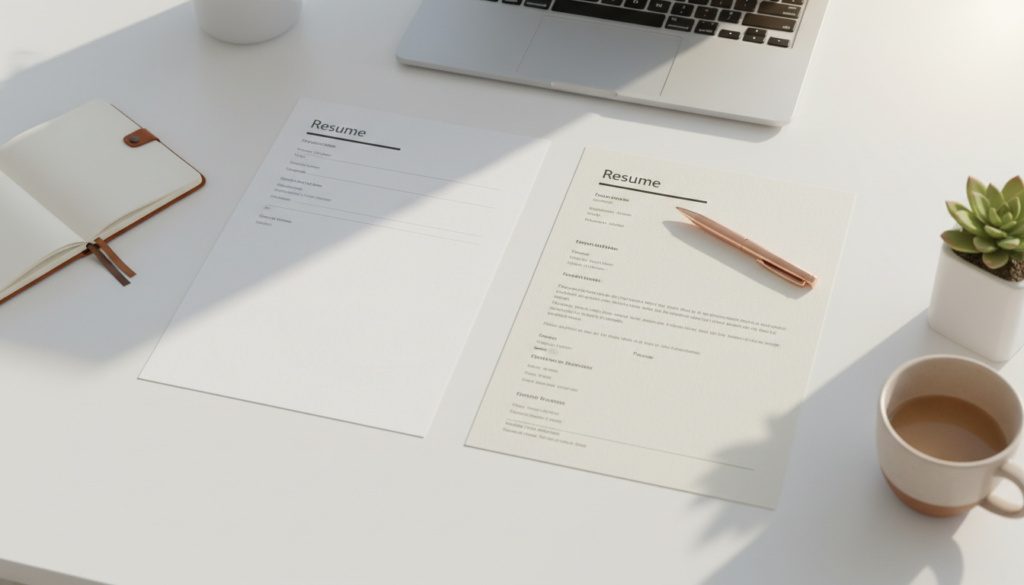
Candidate
Senior Project Manager with 11 years of experience
AI Resume Result
- General leadership summary
- Task-based bullet points
- No clear specialization
- No measurable business outcomes
Result: No interviews after 50 applications
Human Written Resume Result
- Repositioned as delivery and transformation leader
- Highlighted cost savings and efficiency gains
- Structured achievements by business impact
- Aligned experience with target roles
Result: Interview calls within 3 weeks
Resume and LinkedIn Must Work Together
A strong resume alone is not enough anymore. LinkedIn optimization ensures:
- Consistent positioning
- Recruiter visibility
- Stronger credibility signals
AI tools often treat them separately.
Human strategy aligns them into one career narrative.
Signs Your AI Resume Is Holding You Back
You may be stuck if:
- You are applying but getting no responses
- Your resume feels repetitive or generic
- You struggle to explain your achievements clearly
- You keep updating but results do not change
- You feel burned out from constant applications
If this sounds familiar, the issue is likely positioning, not effort.
When Professional Resume Help Makes Sense

A resume writing service becomes valuable when:
- You are targeting competitive roles
- You are changing industries or roles
- You are not getting interview calls
- You need clearer positioning
- You want faster hiring outcomes
Sometimes the problem is not your experience. It is how it is being presented.
FAQs
Why is my resume not getting interviews?
Usually due to weak positioning, lack of measurable impact, or poor ATS alignment.
Are ATS-friendly resumes really important?
Yes. Without proper structure and keywords, your resume may never reach a recruiter.
Is it worth hiring a resume writer?
For mid-career professionals and executives, yes. It improves clarity and interview chances.
How long should a resume be?
1 to 2 pages for most professionals, up to 3 pages for senior roles.
Can a resume help me switch careers?
Yes, if it is strategically rewritten to highlight transferable skills.
What is reverse recruiting?
It is when experts help manage job applications and outreach on your behalf.
Get Expert Help With Your Resume
If your AI-generated resume is not producing results, it is worth understanding why before continuing to apply. Start with a free resume review to identify gaps and opportunities.
You can also:
- Book a free consultation with a resume expert
- Explore tailored resume packages
- Learn about our resume writing standards
- Get support with LinkedIn optimization and cover letters
- Ask about reverse recruiting for full job search support
Visit our resume review page or contact page to get started.
Final Thoughts
AI has made resume writing faster, but not necessarily more effective in real hiring environments.
Because hiring is not about formatting. It is about clarity, relevance, and positioning.
And that still requires human judgment. A good resume does more than list your experience. It tells your story in a way that makes someone want to interview you.